An agent delivery pipeline, live in weeks
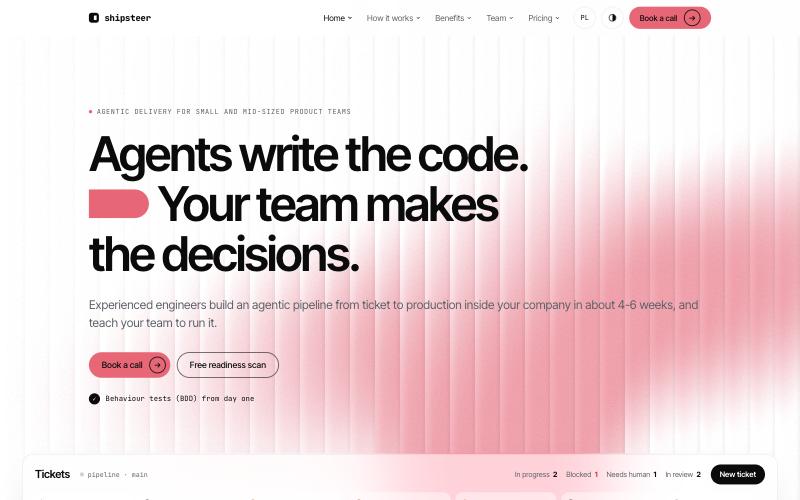
ShipSteer builds an AI agent pipeline inside a client company, from ticket to production, on behaviour-driven tests, and trains the team to run it.
Results
Figures as reported on shipsteer.eu.
- Tickets taken by agents
- 684
- Brought to a tested branch
- 63%
- Finished with no question to a person
- 53%
- Of branches approved by a lead
- 85%
- Production releases in 5 weeks
- 20
- Behaviour-driven (BDD) test scenarios
- 6,900
The brief
Almost every developer now uses AI. Almost no team lets agents work on their own, because nobody can check what an agent changed or why.
ShipSteer needed a pipeline that small and mid-sized product teams could trust with real tickets: agents doing the work, people making every decision, and tests proving each change before it ships.
- Of professionals use AI at work
- 90%
- Never let agents work autonomously
- 61%
- Have little or no trust in AI-written code
- 30%
Market figures from DORA 2025, as quoted on shipsteer.eu.
What we built
Six parts, each one there so a team can let agents work without losing control. In production in about four to six weeks.
A behaviour-driven foundation
Agents first describe how the product behaves today as test scenarios. The team approves them before any agent changes code.
A question layer
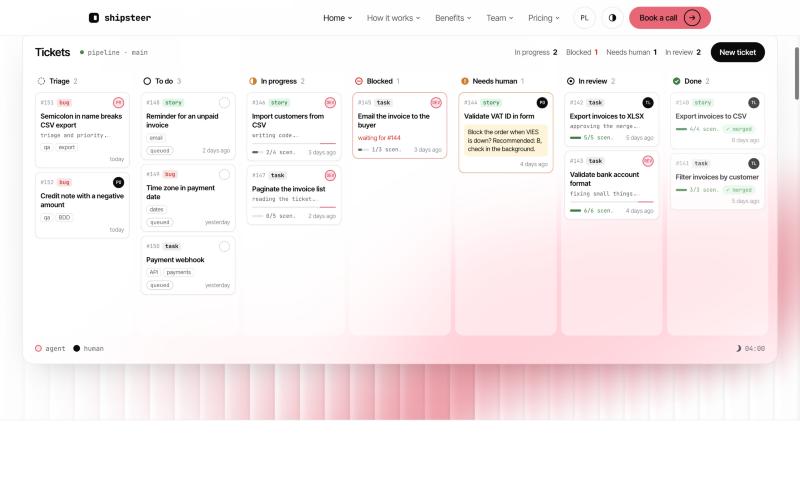
When an agent hits a decision, it asks in the ticket with a recommendation, instead of guessing.
A QA agent
A separate agent tests the running application, not just the code, before a change goes to review.
A morning report
At 07:00 the team gets one report: what the agents finished, what is blocked and what waits for a decision.
Continuous delivery
CI on every merge request, preview environments, promotion from development to production, and fast rollback.
Training and runbooks
The client team learns to run the pipeline, with runbooks and ongoing tuning of prompts and quality gates.